About
About me
My name is Mr. Barlow and I am a high school science teacher living in Melbourne, Australia. Having spent eight years working as a scientist I have now been an educator for significantly longer than that. I have a passion for science education. I believe that as the pace of scientific research accelerates, the average citizen will be faced increasingly with having to grapple with matters of science in their everyday life. I feel that the science education students receive is vitally important for their future success and happiness.
I also think learning is important:
About this blog
The accessibility of information has changed dramatically since the introduction of the World Wide Web. Unfortunately, teaching strategies have struggled to keep pace. The focus on knowledge acquisition through printed texts, handouts, and lecturing no longer develops the skills students will need for their futures. The information is all there, online, free and easily accessible to everyone. As such, teachers no longer need to simply transmit information, they need to impart a desire to question, seek, source and explore. This blog is my attempt to help students, wherever in the world they may be, learn about real, interesting science and technology in the information age.
Welcome to ‘A Bunch of Interesting Stuff‘.
Papers & Presentations
Barlow, T., Building a Cyber Security Stronghold for Better Defence, ICT Schools Summit VIC, Melbourne 2023.
Barlow, T., Strategically enhancing STEM learning from K-12, 6th Annual STEM Education Conference, Sydney 2019.
Barlow, T., Rollout Success and Success After Rollout, Schoolbox Annual Meetup, Melbourne (MCG) 2019.
Barlow, T., Continuous Reporting, Schoolbox User Group Meeting and Schoolbox Annual Meetup, Melbourne 2017.
Barlow, T., Fleming, B., 2016, A science classroom that’s more than a game, Teaching Science, Volume 62, Number 2, p.31-37.
Barlow, T., ‘Gamifying the Classroom‘, August 2015, Apple iBooks Store.
Barlow, T., ‘A journey of pedagogical change‘, ELH SchoolTech 2014, Lorne 2014.
Barlow, T., ‘Luddites to eLearning Leaders in six months – One school’s remarkable turnaround‘, ELH SchoolTech 2013, Lorne 2013. Video.
Barlow, T., 2012, The end of ‘Chalk and Talk’, Teaching Science, Volume 58, Number 1, p.54-57.
Barlow, T., Hill, B., Keeping up with the kids: using current technologies to engage our students, The Australian College of Educators Digital Fair – Word of Mouse, Geelong Grammar 2009.
Barlow, T., Experiencing Learning – The CUE Program, Middle Years of Schooling Association Conference, Melbourne 2008.
Barlow, T., Enhancing Learning with Web 2.0, Middle Years of Schooling Association Conference, Melbourne 2008.
Barlow, T., 2008, Web 2.0: Creating a classroom without walls, Teaching Science, Volume 54, Number 1, p.46-48.
Barlow, T., Ward, W., Ewen-White, K., Forrest, S. Microsatellite Genotyping By Capillary Electrophoresis; Comparison With Flat Bed Gel Electrophoresis, International Congress of Genetics, Melbourne 2003.
In the media
Cyber Security Training and Awareness That Works, TrustedImpact Cyber Security Leadership Series, presented by The Reboot Show, 24 November 2021.
Computer Literacy Begins With Grammar, The Age, 23 April 2017.
School BYO tablet policy easy to take, The Age, 11 April 2013 (scanned article).
St Leonard’s takes the BYOD route, Education Today, 2013 Vol 13 (2) Term 2.
Other
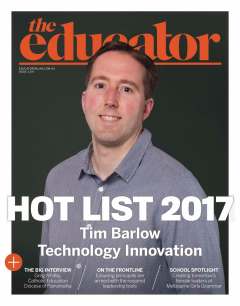
The Educator Magazine ‘Hot List’ 2017.
Australia’s 10 Most Influential Educational Leaders, 2019 (link)
Apple Distinguished Educator
Recognized by Apple as a distinguished educator for innovation, leadership, and educational excellence. Learn more at ade.apple.com.


About my online teaching
In an attempt to make learning easier and more motivating for my students I sometimes create online learning spaces:
- One is obviously this blog, ‘A Bunch of Interesting Stuff‘, designed to keep students interested in, and motivated to learn more about the world around them.
- ‘A Bunch of Interesting Stuff’ the blog is complemented by a podcast, same goals, different delivery medium.
- My senior Biology classes are complemented by my VCE Biology podcast. A way to enable senior students to learn the course material anytime, anywhere.
- My senior Biology students are also some of the first in the world to have access to iOS (iPhone/iPod Touch) apps designed specifically for their course. That is Unit 1 Biology, Unit 2 Biology, Unit 3 Biology and Unit 4 Biology.
- My Year 6 students have access to my amazing electronic book called ‘Year 6 Science‘.
- My Year 9 students have access to two amazing electronic books ‘Year 9 Science’ and ‘Year 9 Science Gamified’.
- My Year 9 Science classes are complemented by my Year 9 Science Podcast. A way to enable middle school students to learn the course material anytime, anywhere.
- ‘reACTION‘ is a Chemistry / Video creation unit of work aimed at late middle school students. The entire course including, notes, homework and assessment details can be found online.
- ‘Life Long Learning‘ is another online Science unit of work. It is a ‘big question’, student directed, research based course.
- Another year 9 unit focussing on forensics can be found here.
- CUE radio is the CUE Program podcast. This is authored by students for their peers to listen to.
- I also take part in a three week Big Experience for year 9 students. The Big Experience blog is a site I developed that informs the school community of the adventures of the students as they experience the world.
As you can tell, I think technology and education go together nicely 😀
 Twitter




 Mr. Barlow's Blog


August 25, 2009 at 8:48 pm |
I am impressed. I would like to emulate this. I have a web site, I am using blogs in one of my ICT classes and have dabbled with podcasts which I find rather daunting as I feel I must script it. It takes so much time. Well done.
September 15, 2009 at 10:06 am |
I am the outreach coordinator for NASA Images. NASA Images (www.nasaimages.org) is the largest collection of NASA media (still images, video & audio) available from a single, searchable site. Created through a Space Act Agreement between NASA and The Internet Archive, a non-profit digital library, NASA Images serves educators, students, researchers, space enthusiast and the general public. The goals of NASA Images include:
– promoting and supporting STEM education
– communicating to the world the important work conducted by NASA
– organizing the incredible variety of media surrounding NASA’s activities under a single, integrated structure for easy access
– archivally preserving NASA’s digital media for future generations
I just wanted to introduce you to NASA Images Mr. Barlow. If you ever wanted to link to the site, write about, or implement NASA Images in any way, we’d be thrilled. Let me know if you have any questions, comments, or ideas. Thank you.
September 15, 2009 at 10:34 pm |
Thanks for the tip Jake.
I just made a post about NASA Images. See it here.
October 14, 2009 at 8:01 am |
Just an Interesting note…. I Did a google for “my” name and Astronomy and found, uhm, us! 🙂
Michael A. Barlow
Backyard astronomer/astrophotographer
October 14, 2009 at 10:18 pm |
Cool!
Nice site Michael, love the title.
😉
April 4, 2010 at 11:15 pm |
Hello Mr. Barlow
I was googling a picture of the Easter bunny, to print out for my children & your picture popped up. I liked your Easter bunny the best & clicked on it. And what a surprise to see your name & blog, my son is named Barlow. It is his paternal grandmother’s maiden name. My husband traveled to Europe with some of his Barlow cousins many years ago & found Barlow relatives from the 1500 hundreds in Turton Bottom. Might you be related? Thank you for your Easter bunny picure, I am attaching it to the email the Easter Bunny sent us. Take care. Tiffany Wareing
April 5, 2010 at 8:53 am |
Hi Tiffany,
I’m not sure if any of my ancestors come from Turton Bottom. My ancestry is European so it is definitely a possibility.
Hope you had a great Easter.
Mr. Barlow
June 28, 2010 at 9:46 pm |
Hi there,
I’m also a Science teacher from Melbourne Australia and am interested in the research you have done, as well as all the fantastic stuff you are doing in you classes! I’ve recently returned from field work in Malaysia studying the forest interior bats as part of the DEECD Energising Science and Mathematics Education Strategy Scholarship Program, and am now wanting to further what I’ve learnt in terms of Education whilst on this trip. I’ve started implementing some new things, but was wondering whether you would help point me in the right direction as I have been thinking about trying some of the things you’re already doing.
If you could contact me, that would be great.
Thanks, and keep up the awesome work!
Kate
March 8, 2011 at 8:36 pm |
HI…
I am currently training to be a biology teacher in Melbourne. I did not do my education in Melbourne and thus, do not have much experience with the education system.
However, i am really keen in making my lessons exciting and useful for the children, i will be teaching. I was hoping you would be able to help me, by outlining some of the steps and details i should incorporate in my lessons plans for specific topics. It would be a really useful guideline for me.
Thank you
March 9, 2011 at 6:56 am |
Hi Reky,
To make your lessons exciting, you just have to be excited. Emotions are contagious.
To make lessons useful, teach the appropriate curriculum.
To make them interesting, mix up the activities you get the kids to do. Do a few internet searches for good lesson ideas.
Cheers,
Mr. Barlow
January 11, 2012 at 12:24 pm |
Hello Mr. Barlow,
Very happy to have stumbled upon your amazing resource!
Lalela (www.lalela.org) is a concept I have been thinking about for a number of years – simple and hopefully useful way of bringing knowledge and eduction to developing regions.
I have partnered with a high school biology teacher in Ethopia who will manage our first pilot study of 10 students.
Was hoping I could send your VCE Biology podcasts as one of the audio resources?
Kind regards,
Jon
January 11, 2012 at 9:24 pm |
Hi Jon,
Sounds like a great project!
Feel free to send the podcasts anywhere you like.
Cheers,
Mr. Barlow
April 24, 2012 at 11:16 am |
Hi Mr Barlow,
I’m a Bio teacher up in sydney and have been recommending your podcasts to my class (there is some good overlap with the HSC syllabus). I’ve had some great responses, but some can’t access it due to it being in itunes (the boarders don’t have itunes access). Do you put it out in mp3 format anywhere else that they could download?
Many thanks,
Bruce
April 24, 2012 at 12:58 pm |
Hi Bruce,
Glad your students are finding them useful!
All the Biology podcasts are available as direct downloads from this site:
http://abunchofinterestingstuff.wordpress.com/
They are actually in m4a format. This is the latest generation of digital audio file, the one after mp3. They will play on any recent computer so your boarders should have no problem.
Cheers,
Mr. Barlow
October 17, 2012 at 6:48 pm |
Good morning Mr Barlow. Definitely in agreement with everyone who has commented thus far. Excellent site! I run communities on a IM platform called Mxit in South Africa. We have about 2 million active users using our sites on a monthly basis. They are mostly lower LSM in under developed areas of South Africa. I would love to bring some of your content to our users. Would you mind if I use some content and reference your site on our side
thanks
Michelle Burgher
October 17, 2012 at 7:12 pm |
No problem.
November 2, 2012 at 6:40 pm |
Where do you work? There is a Mr. Barlow teaching P.E. at my school, Mount Waverly Secondary Collage in Melbourne.
November 2, 2012 at 9:36 pm |
Hi Jarrah,
I do live and work in Melbourne … Have you asked the Mr. Barlow teaching P.E. at your school if he runs this site?
January 3, 2013 at 4:32 am |
hello i am trying to get my kids to remeber things about enzymes, and i see your enzyme song, is there a tune it goes to? or is it on youbue so my kids can watch it??
January 3, 2013 at 8:33 am |
Hi MissAL,
In terms of a tune – I made the song in GarageBand and used one of the default tunes.
The song isn’t on YouTube but all of your kids can download and listen to it here:
[audio src="http://abunchofinterestingstuff.files.wordpress.com/2011/07/enzyme-song.mp3" /]
I hope this helps.
February 20, 2013 at 7:45 am |
Hi,
I am a student researching the topic: are some people born smarter than others. I have a few questions for you. First, are some people born smarter than other, is it nature or nurture, or both? In your opinion, what makes someone smarter than someone else. Also, does anything else affect someones intelligence?
I am hoping you may be able to answer these questions.
-Adam
February 20, 2013 at 9:42 am |
I know everything there is to know about all that there is to know, Except that which I do not know that I do not know.
Michael A. Barlow
(not affiliated with Mr Barlows Blog)
February 21, 2013 at 6:48 am
Wait, what?!
February 21, 2013 at 7:09 am |
Hi Adam,
There is quite a bit of research into intelligence. Genetics certainly plays a role and thus yes, some people are born smarter than others. If you review the literature on this you will come up with lots of information.
Cheers,
Mr Barlow
August 28, 2013 at 8:14 am |
Hi Mr. Barlow,
I really enjoy reading your blog posts! My name is Emily Gottlieb and I recently graduated from Scripps Institution of Oceanography with a Masters in Marine Biodiversity and Conservation. I am currently working as the Education Project Coordinator for Andreas Andersson’s Laboratory at SIO, where we study ocean acidification.
I am writing to tell you about a project that we are working on in the hopes that you would share it on your blog. It is called the “Ocean Acidification Lab Kit” project. I am collaborating with Dr. Andersson to put together lab kits for San Diego high school students. With the kits, classes will be able to collect water samples from local tide pools, record chemical parameters relevant to ocean acidification, and analyze their data.
Last week, the project went live on the crowd-funding website, Microryza. Here is the link to the project: http://bit.ly/1bplvPz .We are fundraising for the cost of the materials, transportation, and training for the students and teachers.
Ocean acidification is the phenomenon of dropping pH levels in the ocean due to the absorption of atmospheric carbon dioxide from human activities. This project will get students directly involved in ocean acidification research and will help us to understand the impact that ocean acidification is having right here off the southern California coast.
People can support this project by sharing the link http://bit.ly/1bplvPz, posting it to Facebook or Twitter, and/or donating.
Thank you for taking the time to read this, and I hope you will consider posting information about this project and our fundraising efforts on your blog!
Best,
Emily
May 1, 2014 at 8:17 pm |
Hi I just checking if you are interested in working with teachers developing effective professional development
April 16, 2015 at 5:02 pm |
Respected Sir,
I have been reading your blogs for a long time and is an admirer of you.
Recently I have developed a website (www.calistry.org) which contains about 80 various online chemistry calculators. Please do have a look and if possible give me your valuable feedback.
Thank you. 🙂
November 8, 2016 at 10:20 pm |
Hi,
My name is Miriam and I’m getting in touch on behalf of the Educational App Store (EAS).
We are an online store providing parents, teachers and students with an easy way to find insight on and download the best educational apps out there.
If you’d like to have a chat about how we may be able to help promote your apps and potentially recommend them directly to subscribed teachers and parents, I’d be happy to arrange a call or send you further information.
What makes our reviews different to others?
Our reviews are done by teachers who have to go through a rubric that we developed over the last three years and that we improved recently with the help of a very well know professor in Educational Technology who is also working with us. So our rubric or assessment is based on facts, not just opinions of what an app is like, how well it works, or how entertaining it is.
Our certification is recognised as one of the leading quality standards in the marketplace, and it is regularly referred to by many non for profit and profit organisations such as Samsung, PC World, TechKnowledge for Schools (former Tablets for Schools) and BAFTA, to name just a few.
I look forward to your reply.
Best,
Miriam
April 14, 2017 at 8:30 am |
Mr. Marlow, I love your blog and love what you are doing. We should connect and see how we can collaborate. Please email me at mlim@se3d.com, I am CEO and founder of a bioprinting startup who is equally passionate about science education.
Looking forward to chat soon
Maya
September 24, 2017 at 11:03 pm |
Hi Mr. Barlow,
Do you have an email address by which I can contact you?
Thanks.
September 25, 2017 at 7:30 pm |
Hi Donovn,
What is the general topic you want to discuss via email?
Cheers,
Mr. Barlow
September 25, 2017 at 7:46 pm
Well, I’ve been working on some graphic designs for some of your work. I can explain in further detail in an email. If you don’t want to share your email that’s fine, but is there any other way that I can contact you with attachments?
September 25, 2017 at 8:25 pm
Hi Donovn,
I don’t really want any graphic designs as attachments sent through. You can post them in a file sharing service (eg. dropbox) and give me the link if you really want to.
Cheers,
Mr. Barlow
September 25, 2017 at 7:49 pm |
Also, make sure you put your email address in when you leave a comment.
September 25, 2017 at 7:52 pm
Is it not there? I’ve filled in in for all of my comments. Hm, it’s donovn@mail.com anyway.
September 25, 2017 at 8:46 pm
https://www.dropbox.com/sh/nwwcb9ve4isd5dr/AAAcrU91mImMyIrhrZjW1qm8a?dl=0
September 30, 2017 at 1:52 pm
Hi Mr. Barlow,
If you please download the files from dropbox so that I can remove the link, that would be great.
Thanks, Donovn.
September 30, 2017 at 9:35 pm
Done. Thanks again Donovn!
July 17, 2018 at 1:16 pm |
Hello Mr Barlow. I am so impressed with all your resources. Have previously purchased a couple of ebooks which are great and listened to some podcasts. Your podcasts have amazing reviews from students who I think are the harshest critics! Wondering if you have resources for physics (year 11) or VCE chemistry. Or if you could direct me to any awesome resources such as yours. My son is In an accelerated program In Geelong and struggling with physics and considering chemistry for VCE as he wants to do engineering. Thanks in advance.
July 17, 2018 at 1:20 pm |
Hi Jo,
Glad they have been helpful.
I’m not aware of any specific resources for those subjects.
Sorry I cannot be of more help.
Cheers,
Mr. Barlow